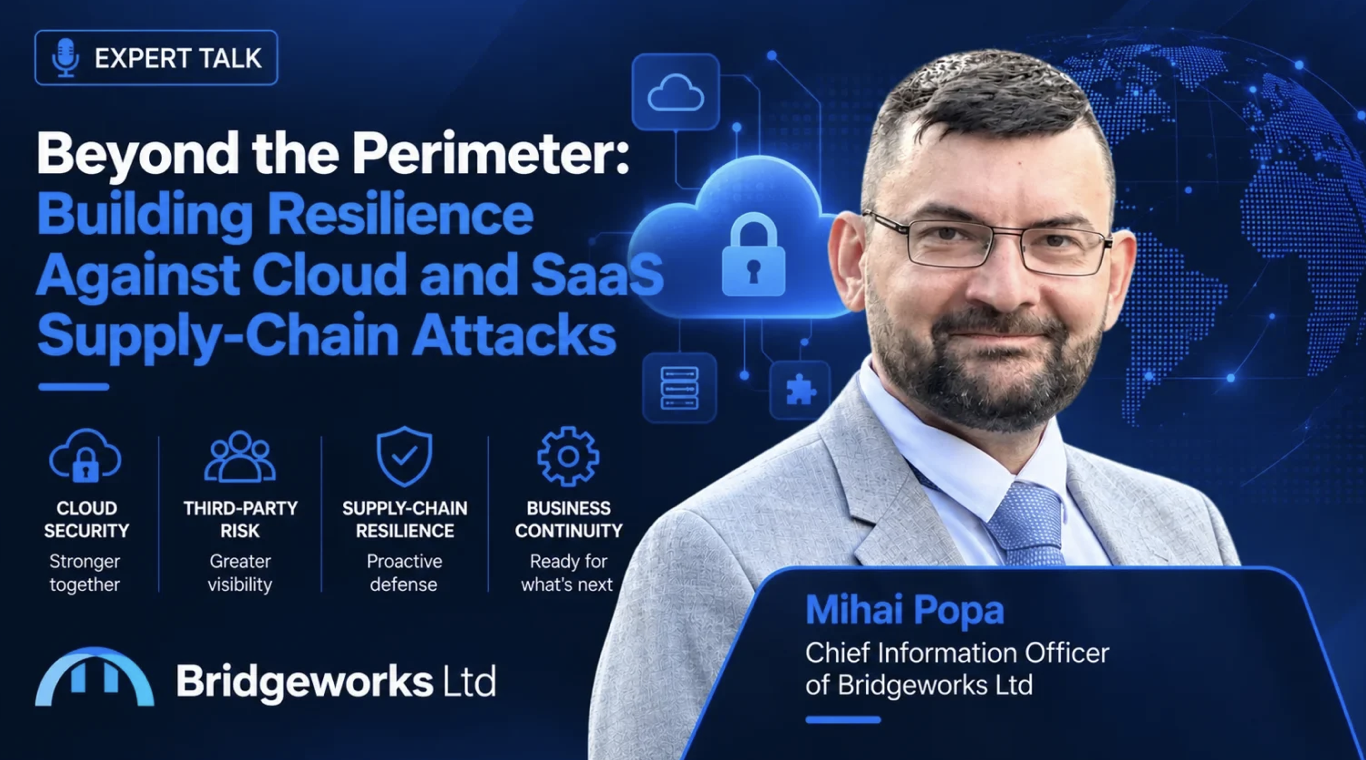
David Trossell, CEO and CTO of Bridgeworks features in this article from MSP Channel Insights to discuss the impact of agentic AI and the operational and commercial outcomes it can deliver.

November 9, 2026
With there being so much hype about agentic AI, there is a need to take a step back to assess the measurable outcomes of artificial intelligence (AI). That’s because it shouldn’t be a fad, or a novelty. Instead, AI should deliver measurable operational outcomes to ensure that technology investments deliver tangible business value instead of superficial innovation.
“Vanity metrics – like tracking the total number of prompts an AI agent issued – only prove usage while failing to prove actual business value. This superficial focus mirrors a broader design flaw across the industry: many forms of AI are treated as an afterthought. For example, rather than being built natively into the core architecture of technologies like SD-WANs, AI is often tacked on as a marketing feature rather than a foundational system optimiser. Similarly, agentic AI models are often presented as being dynamic, deeply integrated into existing workflows, and prone to model decay or data drift over time.”
No matter what kind of AI is being used, or for whatever purpose, an organisations focus must shift from simply deploying a tool to continuously monitoring its impact on network performance. AI is an environment, and to that extent it doesn’t and can’t sit in a silo where AI tools don’t have the means or capacity to deliver value.
From a Managed Service Providers (MSP) perspective, this means that AI must have the ability to interact and integrate with an MSPs entire core stack – everything from security, data pipelines, access permissions, to systems integrations. Whenever AI is judged by its novelty, these dependencies are all too often ignored. In stark contrast, when AI is judged by outcomes, the entire technical ecosystem can function effectively.
Getting real value from AI
First Focus, an MSP operating in Australia and New Zealand, wrote on 22nd October 2026 about Why AI Outcomes Belong Inside Managed Services. In their article, they argue: “Getting real value from AI takes more than giving people access to new tools. It takes the right support, security, data governance, training, and business processes working together. Increasingly, those are not separate from the managed technology environment. They are part of it…”
“A business does not ultimately care whether improving a process required an AI agent, an API, an automation, better permissions, SharePoint remediation, custom development, or training. It cares that the process became faster, safer, or more productive. That is where this becomes particularly relevant to managed services.”
Its also important to note that algorithmic accuracy can be boosted with a technically advanced AI model, creating operational bottlenecks if workflows become disrupted, or if the AI model requires excessive human intervention to override its actions.
Kamlesh GS S. writes on LinkedIn, AI Objectives, Goals, and KPIs: Building Measurable Value from Artificial Intelligence, and argues: “Despite growing investment levels, many organisations still struggle to translate AI initiatives into measurable business outcomes. One of the primary reasons is the absence of clearly defined objectives, strategic goals, and performance indicators.”
“Successful AI adoption requires more than deploying machine learning models or generative AI tools. It requires structured governance, business alignment, measurable outcomes, and continuous performance evaluation. AI programmes that lack clearly defined objectives often become fragmented technology experiments without sustainable operational or commercial impact. This makes AI Objectives, Goals, and Key Performance Indicators (KPIs) essential components of enterprise AI governance and strategic execution.”
There is also a need to justify continuous maintenance costs. AI requires constant updating, and regular bug fixing – more than traditional software does. Unlike traditional software, it needs to be trained and then retrained to counter data drift, which requires much governance. From an MSPs perspective, many of the ongoing operational costs are unjustifiable – particularly if they are judged on their novelty alone. So, concrete evidence is imperative to allow for analysis of AIs return on investment.
Infrafocus therefore claims in its article, Measuring What Matters in AI: “AI does not need more technical measurements. It needs better strategic measurement. The organisations that succeed will be those that treat AI as a capability governed by clear objectives, meaningful KPIs, and transparent performance reporting.”
Acceleration with evidence
WAN Optimisation does not have the ability to transmit and receive encrypted data and network jitter making Big Data and military command and control analyses less accurate. WAN Acceleration, while not agentic AI, is a technology that deploys AI, machine learning, and data parallelisation to mitigate the effects of latency and packet loss. With AI built in from the outset, it delivers strategic network outcomes because its automation is applied to a specific, measurable engineering problem – that being, for example, the problem of slow data backups.
In a proof-of-concept with IBM partner OCF, Bridgeworks tested WAN Acceleration technology PORTrockIT with IBM Storage Scale across a simulated wide-area network. The toughest scenario introduced 300 milliseconds of latency and 0.1% packet loss—conditions that severely restrict conventional TCP throughput. PORTrockIT used artificial intelligence, machine learning along with data parallelisation to keep packets moving and bandwidth productive.
PORTrockIT completed backup jobs 50 times faster than a traditional network architecture. This result demonstrates a practical MSP outcome: shorter backup windows, faster recovery readiness, and stronger service performance without replacing existing infrastructure.
WAN Acceleration continuously analyses data flows and takes a no-touch approach to data management. Organisations often feel the need to keep up with novelty, the new technologies that are emerging every month of every year, but WAN Acceleration demonstrates ROI by allowing them to maintain their existing storage and network infrastructure – using AI to do the heavy lifting to enable voluminous amounts of data to be transferred over large distances. Unlike traditional approach to mitigating latency and packet loss, an organisations data centres or disaster recovery sites don’t need to be situated in close proximity to each other. They can be farther apart.
Practical MSP value
For MSPs, the practical distinction is equally important. PORTrockIT also works as an overlay for SD-WANs, where it can accelerate encrypted, compressed, and deduplicated data without inspecting or changing it, and does not require customers to replace existing transport or redesign applications around a proprietary management layer.
This allows outcomes to be tracked in operational terms: shorter backups and recovery windows, faster replication, cloud transfers, higher throughput, reliable remote data access, fewer performance support issues, and better use of infrastructure customers already own. All of these have a measurable operational and financial impact.
That is why the AI used is not the product story by itself. Its value lies in converting constrained WAN performance into repeatable service improvements that an MSP can demonstrate against baselines and service-level targets. Novelty asks whether AI is present; an outcome-led assessment determines whether data moved faster and more reliably, whether recovery objectives improved, and whether – for example, a voluminous data transfer- was achieved securely without unnecessary cost or disruption.
Measurable outcomes define innovation
Ultimately, credible, production-ready AI in the channel should be judged not by novelty, but by the operational and commercial outcomes it delivers. For MSPs, intelligent WAN Acceleration offers a practical example: automation can mitigate latency and packet loss, improve bandwidth utilisation, and strengthen service reliability without forcing customers to redesign existing infrastructure.
The real test is therefore whether AI solves a defined engineering or operational problem and produces improvements that can be measured against business and service-level objectives. After all, innovation matters most when it translates into faster, safer, and more dependable services—and when MSPs can clearly prove that value to customers.