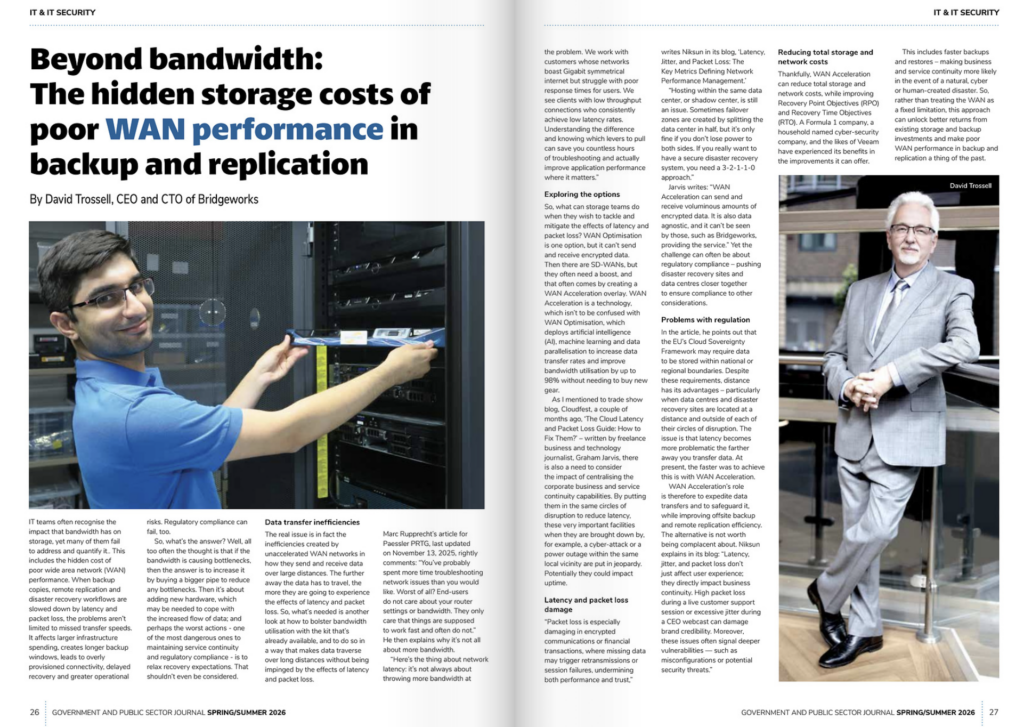
David Trossell, CEO & CTO of Bridgeworks speaks to Government Public Sector Journal (GPSJ) about how WAN Acceleration improves all areas of WAN performance.

SPRING / SUMMER
IT teams often recognise the impact that bandwidth has on storage, yet many of them fail to address and quantify it.. This includes the hidden cost of poor wide area network (WAN) performance. When backup copies, remote replication and disaster recovery workflows are slowed down by latency and packet loss, the problems aren’t limited to missed transfer speeds. It affects larger infrastructure spending, creates longer backup windows, leads to overly provisioned connectivity, delayed recovery and greater operational risks. Regulatory compliance can fail, too.
So, what’s the answer? Well, all too often the thought is that if the bandwidth is causing bottlenecks, then the answer is to increase it by buying a bigger pipe to reduce any bottlenecks. Then it’s about adding new hardware, which may be needed to cope with the increased flow of data; and perhaps the worst actions – one of the most dangerous ones to maintaining service continuity and regulatory compliance – is to relax recovery expectations. That shouldn’t even be considered.
Data transfer inefficiencies
The real issue is in fact the inefficiencies created by unaccelerated WAN networks in how they send and receive data over large distances. The further away the data has to travel, the more they are going to experience the effects of latency and packet loss. So, what’s needed is another look at how to bolster bandwidth utilisation with the kit that’s already available, and to do so in a way that makes data traverse over long distances without being impinged by the effects of latency and packet loss.
Marc Rupprecht’s article for Paessler PRTG, last updated on November 13, 2025, rightly comments: “You’ve probably spent more time troubleshooting network issues than you would like. Worst of all? End-users do not care about your router settings or bandwidth. They only care that things are supposed to work fast and often do not.” He then explains why it’s not all about more bandwidth.
“Here’s the thing about network latency: it’s not always about throwing more bandwidth at the problem. We work with customers whose networks boast Gigabit symmetrical internet but struggle with poor response times for users. We see clients with low throughput connections who consistently achieve low latency rates. Understanding the difference and knowing which levers to pull can save you countless hours of troubleshooting and actually improve application performance where it matters.”
Exploring the options
So, what can storage teams do when they wish to tackle and mitigate the effects of latency and packet loss? WAN Optimisation is one option, but it can’t send and receive encrypted data. Then there are SD-WANs, but they often need a boost, and that often comes by creating a WAN Acceleration overlay. WAN Acceleration is a technology, which isn’t to be confused with WAN Optimisation, which deploys artificial intelligence (AI), machine learning and data parallelisation to increase data transfer rates and improve bandwidth utilisation by up to 98% without needing to buy new gear.
As I mentioned to trade show blog, Cloudfest, a couple of months ago, ‘The Cloud Latency and Packet Loss Guide: How to Fix Them?’ – written by freelance business and technology journalist, Graham Jarvis, there is also a need to consider the impact of centralising the corporate business and service continuity capabilities. By putting them in the same circles of disruption to reduce latency, these very important facilities when they are brought down by, for example, a cyber-attack or a power outage within the same local vicinity are put in jeopardy. Potentially they could impact uptime.
Latency and packet loss damage
“Packet loss is especially damaging in encrypted communications or financial transactions, where missing data may trigger retransmissions or session failures, undermining both performance and trust,” writes Niksun in its blog, ‘Latency, Jitter, and Packet Loss: The Key Metrics Defining Network Performance Management.’
“Hosting within the same data center, or shadow center, is still an issue. Sometimes failover zones are created by splitting the data center in half, but it’s only fine if you don’t lose power to both sides. If you really want to have a secure disaster recovery system, you need a 3-2-1-1-0 approach.”
Jarvis writes: “WAN Acceleration can send and receive voluminous amounts of encrypted data. It is also data agnostic, and it can’t be seen by those, such as Bridgeworks, providing the service.” Yet the challenge can often be about regulatory compliance – pushing disaster recovery sites and data centres closer together to ensure compliance to other considerations.
Problems with regulation
In the article, he points out that the EU’s Cloud Sovereignty Framework may require data to be stored within national or regional boundaries. Despite these requirements, distance has its advantages – particularly when data centres and disaster recovery sites are located at a distance and outside of each of their circles of disruption. The issue is that latency becomes more problematic the farther away you transfer data. At present, the faster was to achieve this is with WAN Acceleration.
WAN Acceleration’s role is therefore to expedite data transfers and to safeguard it, while improving offsite backup and remote replication efficiency. The alternative is not worth being complacent about. Niksun explains in its blog: “Latency, jitter, and packet loss don’t just affect user experience; they directly impact business continuity. High packet loss during a live customer support session or excessive jitter during a CEO webcast can damage brand credibility. Moreover, these issues often signal deeper vulnerabilities — such as misconfigurations or potential security threats.”
Reducing total storage and network costs
Thankfully, WAN Acceleration can reduce total storage and network costs, while improving Recovery Point Objectives (RPO) and Recovery Time Objectives (RTO). A Formula 1 company, a household named cyber-security company, and the likes of Veeam have experienced its benefits in the improvements it can offer.
This includes faster backups and restores – making business and service continuity more likely in the event of a natural, cyber or human-created disaster. So, rather than treating the WAN as a fixed limitation, this approach can unlock better returns from existing storage and backup investments and make poor WAN performance in backup and replication a thing of the past.
Click here to read the article on GPSJ.